

Have you considered outsourcing some work but kept putting it off because you are not sure where to start?
For some people, it is obvious what can be handed over to someone else. For many, it feels like an overwhelming process. Working with a virtual assistant does not have to begin with a long, detailed specification or a decision to hand over a large part of your business. It can start with just the one or two tasks that are taking too much of your time.
For example, you might ask a VA to create an infographic, make a flyer to promote a new coaching group, update contact details on a website, prepare a transcription or set up a Mailchimp account.
These five steps offer a practical starting point.
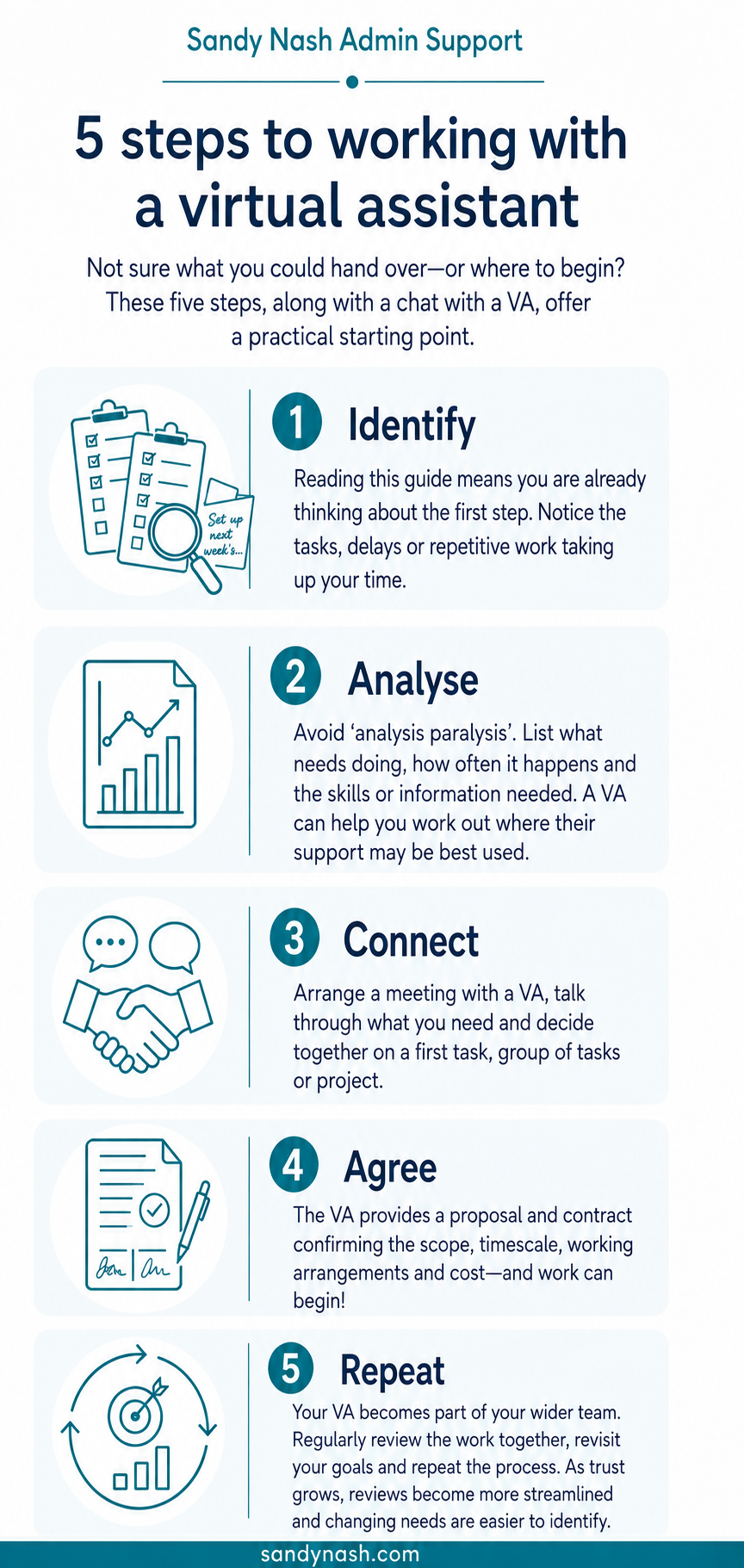
1. Identify what is taking your time
By reading this guide, you are already thinking about the first step. You have recognised that something is taking you too much time and that there may be another way to deal with it.
Start by noticing the work that keeps being postponed, interrupts more important activity or takes you longer than it should. It might be routine administration, website updates, preparing reports, coordinating bookings, organising information or following up actions.
It is also worth considering who is currently doing that work. Valuable owner or management time is often spent on tasks that can be outsourced effectively, freeing that person to concentrate on the areas where they add the greatest value.
My original business strapline was Creating time for business. That is still relevant today, although the support I provide now extends well beyond “just” traditional administration.
2. Analyse what can sensibly be handed over
You do not have to complete this analysis alone. In fact, many clients prefer Steps 2 and 3 to happen together. They would rather have some help completing the analysis than face another task before they can ask for support.
This is where it is easy to become stuck in “analysis paralysis”. You know that support could help, but deciding what to hand over, and how to explain it, can become another task in itself.
List what needs doing, how often it happens and any timescales involved. Consider which skills, information, systems or access are needed, and whether the work requires your personal judgement or could be progressed by somebody else.
Not every task is suitable for delegation. Some decisions can only be made by you. Other work can be prepared, organised or completed independently before coming back to you for review or approval.
I can help you look at how the work is currently being done, ask the right questions and identify a sensible place to begin.
3. Connect and discuss what you need
The next step, which as already mentioned could begin during the analysis stage, is to speak to a virtual assistant. An introductory conversation gives us the opportunity to talk through what is taking your time, the result you are hoping for and any relevant deadlines or priorities.
You do not need to arrive with a perfectly organised brief. Notes, examples or a collection of half-finished tasks may be enough to start the discussion. If you are not sure exactly what support you need, working that out can be, and often is, part of the conversation.
This is also an opportunity for both of us to decide whether we are likely to work well together. A good working relationship depends on communication, trust and a shared understanding of what needs to be achieved.
We can then identify a sensible first task, or sometimes a group of tasks, to hand over. Starting with one or two clearly defined pieces of work allows us to learn how each other works without requiring you to commit to a large or longer-term arrangement.
4. Agree how the work will be done
Before work begins, we agree what is included (the scope), the proposed timescale, the cost, what information or access is needed and how we will communicate. Even for a small piece of work, there should be a clear proposal, written agreement and contract.
My payment terms are agreed in advance and payment is made before work begins. This keeps the arrangement clear for both of us and means there is no uncertainty once the work is underway.
Working with a virtual assistant is not the same as employing somebody. A VA is an independent service provider who brings their own experience, systems and way of working. You do not need to provide a salary, employment benefits, equipment or day-to-day supervision, and you pay for the support you actually need.
We will discuss whether the work is arranged with an hourly charge for time or a fixed fee for completion of a particular piece of work.
That does not mean the VA remains an outsider. A good VA can become a trusted part of your wider team, understand how your organisation operates and work autonomously towards the agreed result. In many cases, that combination of flexibility, experience and independence can offer better value than using valuable management time or employing somebody for work that is not needed on a full-time or even regular part-time basis.
5. Repeat, review and adapt
This is an ongoing process. As I begin working alongside you and become a trusted part of how your business operates, we can regularly review both what your business needs and how I can best support that need.
We can consider what has been useful, what could be improved and where you add the most value to your business. We can then revisit the earlier steps, identify other work that could sensibly be delegated and agree how I can best continue supporting your goals.
Support can remain occasional, develop into regular help or simply end when the task is finished. As your business or organisation changes, the support it needs may change too.
Reviewing the arrangement keeps it useful. As trust and rapport develop, these conversations usually become quicker and I can work increasingly autonomously, with less direction needed from you.
Could some practical support help?
If you have recognised work that is taking more of your time than it should, you do not need to complete any of the steps mentioned here at all before getting in touch. We can start with a short conversation about what you might need and whether I am the right person to help.